Sometimes clarity comes not from doing more—but from understanding the difference between two things that seem similar.
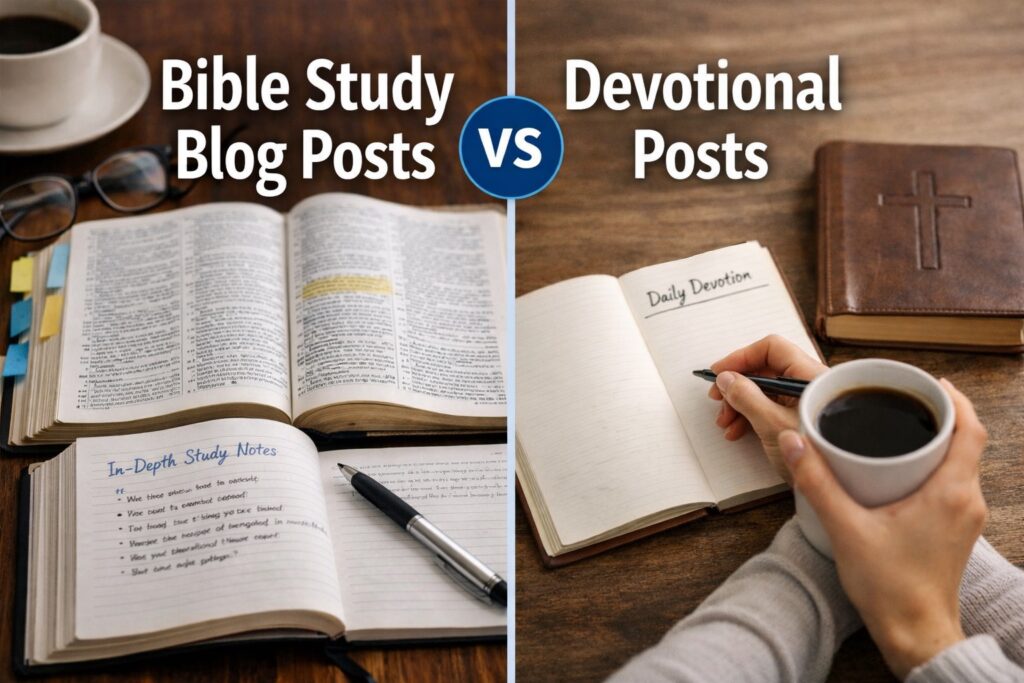
If you’ve ever wondered about Bible study blog posts vs devotional posts, you’re not alone. Many Christian writers use these formats interchangeably, but they serve different purposes and speak to readers in different ways.
Understanding this difference will not only improve your writing—it will help you serve your audience more effectively and build a clearer, more focused blog.
Ready to launch your devotional blog the right way?
Start the 60-minute Quick-StartWhat Is a Devotional Blog Post?
A devotional blog post is designed to encourage, inspire, and help readers reflect on Scripture in a simple and personal way.
It typically:
- Focuses on one verse or short passage
- Shares a clear, single message
- Includes a practical takeaway
- Often ends with a short prayer
Devotionals are meant to be:
- Short
- Relatable
- Easy to apply
They are ideal for readers who want encouragement in their daily lives.
What Is a Bible Study Blog Post?
A Bible study blog post goes deeper into understanding Scripture.
It typically:
- Explores a passage in more detail
- Examines context and meaning
- May include multiple verses
- Focuses on teaching and understanding
Bible study posts are often:
- Longer
- More detailed
- More structured
They are ideal for readers who want deeper insight and learning.
The Core Difference Between the Two
The main difference comes down to purpose.
Devotional posts focus on encouragement and application
Bible study posts focus on understanding and explanation
Both are valuable, but they serve different needs.
When to Write a Devotional Post
Choose a devotional format when you want to:
- Encourage someone
- Share a personal insight
- Offer a simple message
- Help readers apply Scripture quickly
Devotionals are especially effective when:
- Readers are short on time
- Someone needs immediate encouragement
- You want to connect emotionally
When to Write a Bible Study Post
Choose a Bible study format when you want to:
- Teach deeper meaning
- Explore a passage in detail
- Explain context or background
- Help readers grow in understanding
These posts are better when:
- The topic requires explanation
- You want to go deeper into Scripture
- Readers are ready for more study
Real-Life Examples of When to Use Each Format
Understanding the difference becomes easier when you think about real situations.
For example:
If someone is feeling anxious and searching for peace, a devotional post works best. They are not looking for a detailed breakdown—they need a clear, simple reminder of God’s presence.
On the other hand, if someone is studying a specific passage and wants to understand what it means, a Bible study post is more helpful.
In simple terms:
- Devotionals meet emotional and spiritual needs quickly
- Bible studies support deeper learning and understanding
Knowing this helps you choose the right approach every time you write.
Why Most Devotional Blogs Focus on Devotionals
If your blog is centered on encouragement, devotionals should be your primary format.
Why?
Because they:
- Are easier to read
- Fit into daily routines
- Connect quickly with readers
As you continue learning how to start a devotional blog, focusing on devotionals helps you stay aligned with your purpose.
Can You Use Both on the Same Blog?
Yes, but with intention.
You can:
- Primarily write devotionals
- Occasionally include Bible study posts
This creates balance:
- Encouragement (devotionals)
- Depth (Bible study)
But avoid mixing the two within the same post.
Keep each post clear in its purpose.
Avoid Blending the Two Formats
One common mistake is trying to combine devotional and Bible study formats into one post.
This often leads to:
- Confusion
- Lack of clarity
- Overly long content
Instead:
- Choose one format per post
- Stay consistent with that format
Clarity improves both readability and impact.
Think About Your Audience First
Your audience determines which format to use.
Ask:
- Are they looking for encouragement?
- Or deeper understanding?
If your audience is busy and looking for quick encouragement, devotionals will serve them best.
Build a Clear Content Strategy
A strong devotional blog has a clear direction.
You might choose:
- 80% devotional posts
- 20% Bible study posts
This keeps your content focused, consistent, and balanced.
Why This Clarity Matters for Your Blog
When your content is clear, your blog becomes easier to understand.
Readers know:
- What to expect
- What they will receive
- Why they should return
This builds trust and consistency.
How Clear Content Positioning Builds Authority
When your blog consistently uses the right format for the right purpose, it becomes easier for both readers and search engines to understand your content.
Readers begin to recognize:
- Where to go for encouragement
- Where to go for deeper study
This clarity builds trust.
It also strengthens your blog’s overall structure, making your content feel more organized and intentional.
Over time, this kind of consistency helps establish your site as a reliable source within your niche.
How This Helps Your Writing Process
Understanding the difference also makes writing easier.
Instead of asking what should this be, you already know if it is a devotional or a Bible study.
That clarity simplifies everything.
Quick Comparison Checklist
Devotional Post:
- ✔ One Scripture
- ✔ One message
- ✔ Simple explanation
- ✔ Practical takeaway
- ✔ Short length
Bible Study Post:
- ✔ Multiple verses
- ✔ Deeper explanation
- ✔ Context included
- ✔ Teaching focus
- ✔ Longer format
Final Thoughts
Understanding Bible study blog posts vs devotional posts helps you write with clarity, purpose, and direction.
Both formats are valuable.
But when you know the difference, you can use each one intentionally—serving your readers in the way they need most.
Clarity in your writing leads to stronger impact.
Start Your Devotional Blog Today
Follow the step-by-step system and launch your blog with confidence.
Start the 60-minute Quick-StartRecommended Hosting Providers:
WPX Hosting | SiteGround | InterServer | GreenGeeks | ScalaHosting | Kinsta
✨ About the Author
I’m Nehemiah Maxwell, a faith-driven writer and content strategist helping Christian women turn ministry ideas into thriving online platforms. Through WhichHostIsBest.com, I teach step-by-step hosting and WordPress strategies that make ministry setup simple—so you can focus on what matters most: serving others with clarity and grace. I believe that when faith, clarity, and excellence come together, Kingdom impact multiplies. I’m also the author of If We Hold Fast: What Hebrews Reveals About Salvation, Endurance, and Eternal Security. You can also read why I built WhichHostIsBest.com.