
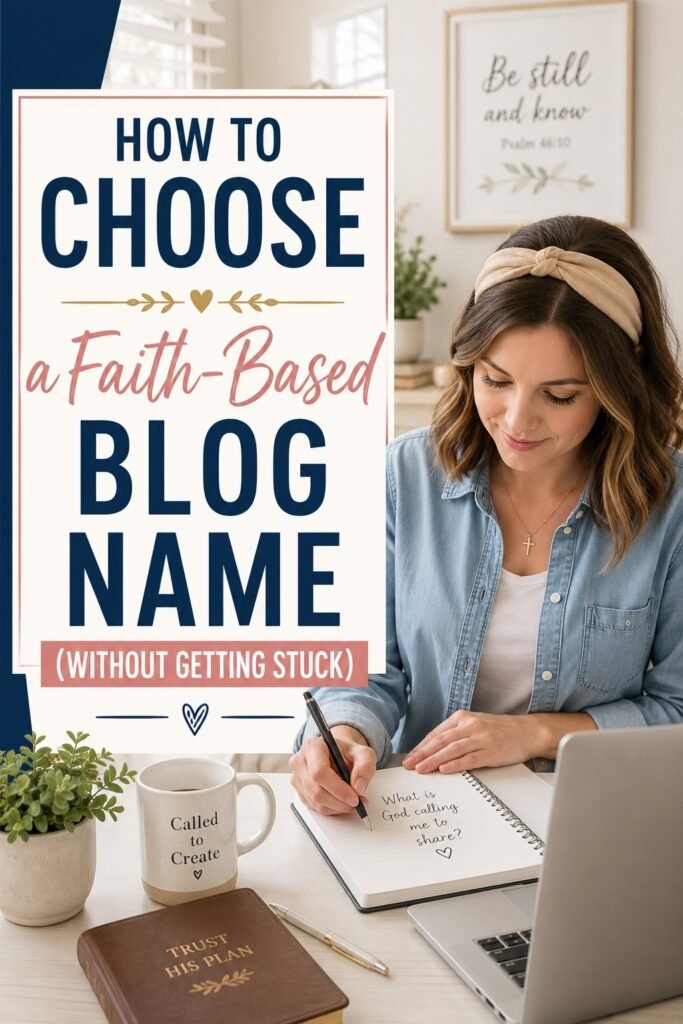
How to Choose a Faith-Based Blog Name (Without Getting Stuck)
Choosing a name for your Christian blog can feel more difficult than expected. You may want it to sound meaningful, reflect your faith, fit your ministry, and still leave room for future growth. With so many possibilities, it is easy to keep brainstorming without ever moving forward. The good news is that your blog name does not have to be perfect. It simply needs to communicate your message clearly enough for you to begin.
Ready to Build Your Christian Blog?
Follow the free Click-by-Click WordPress Faith Blog Builder and begin creating your ministry website one simple step at a time.
Start the FREE 60-Minute Quick-StartStart With the Message, Not the Name
One of the easiest ways to get stuck is to begin by searching for clever words instead of clarifying what you want your blog to accomplish. Before choosing a name, take a few minutes to think about the people you hope to serve and the message you feel led to share.
Ask yourself:
- Who do I believe God is calling me to encourage, teach, or support?
- What topics will I most likely write about?
- What change do I hope readers experience through my content?
- What part of my testimony, experience, or spiritual growth may help someone else?
Your answers do not have to describe your entire future ministry. They only need to give you a clear starting direction. For example, a woman who wants to encourage mothers through difficult seasons may choose a different name from someone who plans to publish Bible studies or teach beginner Christian bloggers.
Once the purpose becomes clearer, possible names usually begin to feel more natural. A strong name grows out of the ministry message rather than trying to create the ministry message by itself.
Choose a Name That Is Clear Before It Is Clever
A creative name can be memorable, but clarity matters more than cleverness. When someone sees your blog name on Pinterest, Google, Facebook, or an email, she should be able to form at least a general idea of what your website offers.
A name such as Grace for the Weary Heart immediately suggests Christian encouragement during difficult seasons. A name such as Growing Through Scripture suggests Bible study and spiritual growth. Neither name explains every article the blog will contain, but both give readers a meaningful clue.
Be careful with names that are so abstract that only you understand them. A phrase connected to a private memory or personal experience may be meaningful, but it could confuse new readers unless the rest of your branding clearly explains it.
You do not have to place words such as Christian, Bible, faith, or ministry in your name. However, the name and supporting tagline should work together to make your purpose understandable.
Make It Easy to Remember, Spell, and Share
Your blog name may eventually be spoken during conversations, shared at church, mentioned on a podcast, printed on a resource, or typed into a browser. A name that sounds beautiful but is difficult to spell can create unnecessary confusion.
Try saying the name aloud several times. Imagine telling it to someone who cannot see it written down. Would she know how to spell it? Would you need to explain unusual punctuation, numbers, abbreviations, or creative spellings?
Simple names are often easier to build into recognizable brands. Consider avoiding:
- Unnecessary numbers or symbols
- Words that are commonly misspelled
- Very long phrases
- Unusual spellings of familiar words
- Several words that sound alike when spoken
A useful test is to tell the name to someone once and ask that person to repeat it a few minutes later. If she remembers it easily, that is a positive sign.
Give Your Ministry Room to Grow
Your first idea for a blog may be narrower than the ministry you eventually build. You might begin by writing weekly devotionals and later add Bible studies, printable journals, videos, courses, books, speaking, or a podcast.
Because of this, avoid choosing a name that limits you too tightly unless you are confident that the narrow focus is central to your long-term calling. A name built around one temporary season, one specific age group, or one content format may become difficult to use later.
For example, a name focused entirely on “daily devotionals for newly married women” might feel restrictive if the ministry later expands to serve Christian women in many stages of life. A broader name can still support a focused beginning while leaving room for growth.
This does not mean your name should be vague. The goal is to choose something specific enough to communicate your direction but flexible enough to grow with your ministry.
Create a Short List Instead of Searching Forever
Endless brainstorming can make every option feel less certain. Instead of trying to find one perfect name immediately, create a short list of five to ten possibilities.
You can build your list by combining words connected to:
- Your primary message, such as grace, hope, healing, prayer, purpose, or Scripture
- Your audience, such as women, mothers, families, writers, or ministry leaders
- Your desired outcome, such as growth, peace, courage, restoration, or deeper faith
- Christian imagery, such as roots, light, paths, rivers, seeds, anchors, or gardens
After creating the list, step away from it for a day. When you return, remove any names that are difficult to understand, spell, or remember. Then compare the remaining choices using the same standards rather than relying only on emotion.
Use the Five-Question Faith-Based Blog Name Test
Before making your final choice, ask these five questions:
- Does this name reflect the message I currently feel led to share?
- Would a new reader understand the general direction of the blog?
- Is the name easy to remember, spell, pronounce, and share?
- Could this name still fit if the ministry grows over the next five years?
- Can I secure a suitable domain name without creating a confusing variation?
A name does not need to receive a perfect score in every area, but serious concerns should not be ignored. If a name is already heavily associated with another ministry, unavailable as a practical domain, or difficult for readers to understand, another option may serve you better.
Check the Name Before You Commit
Once you have one or two strong choices, search each name online. Look for ministries, businesses, podcasts, books, social media accounts, or organizations already using the same or a very similar name.
You should also check whether a matching domain name is available. A domain is the address people will use to visit your website. Ideally, it should match your blog name as closely as possible.
If the exact domain is unavailable, do not immediately add random numbers or awkward punctuation. Consider a natural variation using words such as ministry, faith, blog, devotional, living, or online—only when the added word fits the brand.
You should also avoid choosing a name that could create trademark or brand-confusion concerns. A basic online search does not replace legal advice, but it can help you identify obvious conflicts before you invest time and money.
Do Not Wait for a Perfect Spiritual Feeling
Prayer should absolutely be part of choosing a faith-based blog name. However, prayer does not always produce one dramatic moment in which a perfect name suddenly appears.
God may guide you through wisdom, research, counsel, peace, practical availability, and the willingness to take the next faithful step. You may have several good options rather than one spiritually acceptable option and several wrong ones.
Do not place more spiritual weight on the name than Scripture requires. Your blog name is important, but it is not the source of your ministry’s fruitfulness. A beautiful name cannot replace faithful content, genuine service, sound teaching, consistency, and dependence on God.
At some point, continued hesitation stops being careful planning and becomes avoidance. Once you have prayed, evaluated the name wisely, checked its availability, and confirmed that it fits your direction, give yourself permission to move forward.
Why Owning Your Ministry Website Matters
Choosing your blog name is only the beginning. Your ministry also needs a stable online home where readers can find your articles, devotionals, resources, testimony, and future projects.
Social media can help people discover your message, but you do not own those platforms. Facebook, Pinterest, Instagram, TikTok, and YouTube control their systems, algorithms, reach, and account rules. A platform can change how content is distributed or restrict an account without giving you control over the decision.
A self-hosted website gives your ministry a central home that you manage. Your social media posts, Pinterest pins, videos, and emails can all point readers back to one place where they can learn more, join your email list, and explore your content.
Think of social media as the roads people travel to discover your ministry. Your website is the home where they can stay, receive help, and develop a lasting connection with your message.
To explore the purpose behind building your own ministry website, read Why Start a Faith Blog?
Your Simple Blueprint for Launching a Christian Blog
Step 1: Finalize Your Blog Name
Choose the strongest name from your short list using the five-question test. Confirm that it fits your message, is easy to share, and provides enough room for future growth.
Step 2: Choose Reliable Website Hosting
Website hosting stores your blog and makes it accessible online. Look for a host that supports WordPress, provides dependable assistance, protects your website, and offers a beginner-friendly setup process.
You can compare trusted providers in the WHIB guide to the Best Hosting for Christian Blogs.
Step 3: Register Your Domain Name
Secure the domain that most closely matches your blog name. Keep it short, clear, and easy to type. Registering the domain gives your ministry a professional web address that can remain connected to your work as it grows.
Step 4: Install WordPress and Begin Building
WordPress allows you to create pages, publish articles, organize content, add images, and expand your ministry website without needing advanced coding skills. Most beginner-friendly hosting companies provide a simple installation process.
Step 5: Follow the Free Quick-Start Guide
You do not have to complete the technical setup alone. The free Click-by-Click WordPress Faith Blog Builder walks you through the process in a clear order so you can move from choosing hosting to building your Christian website without becoming overwhelmed.
Stop Searching and Start Building
Choose a meaningful name, secure your ministry’s online home, and follow the free beginner-friendly guide to begin building your Christian blog today.
Start the FREE 60-Minute Quick-StartFinal Thoughts
Your faith-based blog name does not need to express every part of your calling or predict everything your ministry may become. It needs to be clear, meaningful, memorable, and strong enough to help you begin.
Pray about the decision, use wisdom, check the practical details, and then move forward. The name is the doorway, but the ministry will be built through the message you faithfully share after the door is opened.
Continue with Why Start a Faith Blog?, compare the Best Hosting for Christian Blogs, or begin the FREE Click-by-Click WordPress Faith Blog Builder.