
Start With the Ministry, Not the Technology
One of the easiest mistakes to make is choosing the technology before you’ve clearly identified the ministry. You might think: “Maybe I should start a blog.” Or: “Everybody is making videos. Maybe I need a YouTube channel.” Or: “I suppose I need a website.” But none of those things is the ministry itself. They’re tools. Before choosing one, ask yourself a few more important questions:- Who do I feel especially drawn toward helping?
- What problem, struggle, question, or spiritual need keeps getting my attention?
- What do people already come to me for?
- Do I communicate best through writing, speaking, teaching, conversation, prayer, video, or something else?
- What would genuinely help the people I’m hoping to serve?
Your Online Ministry May Look Different From Someone Else’s
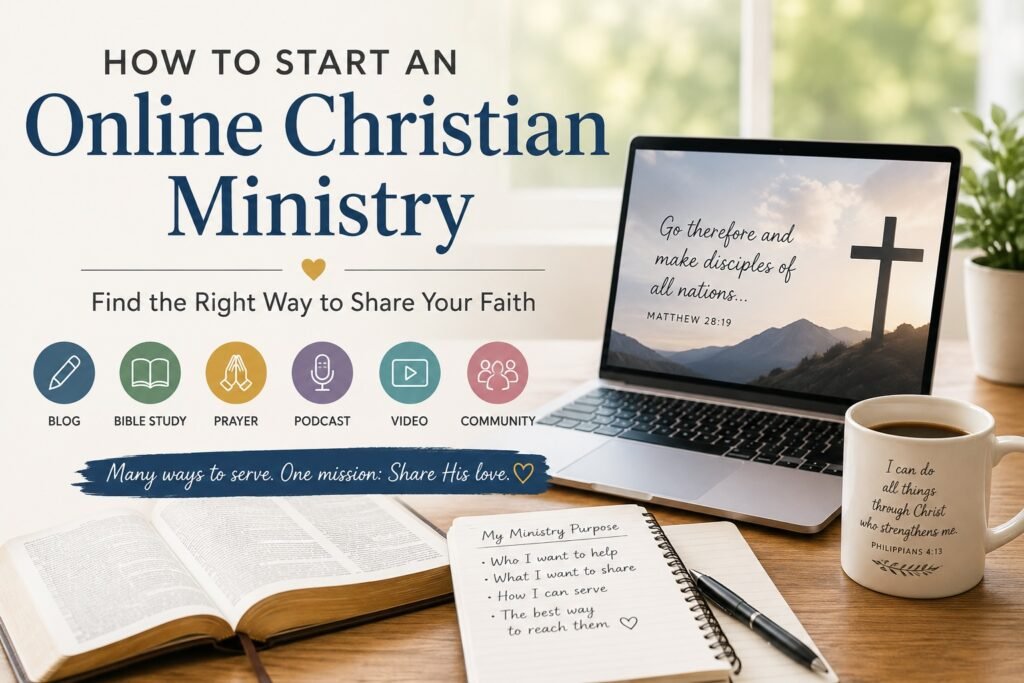
There isn’t one correct model for online Christian ministry. For one person, ministry online might mean publishing thoughtful Bible teaching every week. For another, it might mean leading an online Bible study. Someone else may create short devotional videos. Another person may build a prayer ministry where people can submit requests and receive encouragement. A woman who has walked through grief, motherhood, caregiving, divorce, financial hardship, or another difficult season might feel drawn toward encouraging women walking through something similar. Someone who loves studying Scripture may be better suited to creating Bible-study resources. And someone who communicates beautifully through conversation may discover that podcasting fits her far better than writing articles ever would. That’s why you shouldn’t begin by asking: “Which platform should I use?” Begin with: “How can I best serve the people I’m trying to reach?”Here Are Some Ways an Online Christian Ministry Can Take Shape
You don’t have to choose from a predetermined list, but seeing the possibilities can make the idea of “online ministry” much easier to understand.1. Christian Writing or Blogging Ministry
If writing is how you naturally communicate, a Christian blog or faith-based website may be a strong fit. You might publish devotionals, Bible studies, personal testimony, Christian encouragement, practical guidance, or resources for a particular group of people. A website also gives your writing a permanent home that you control rather than leaving everything on a social-media platform.2. Online Bible Study Ministry
You might teach through live video meetings, recorded lessons, written studies, downloadable worksheets, email lessons, or some combination of these. You could begin very simply with a small group rather than trying to create a large ministry immediately.3. Online Prayer Ministry
A prayer ministry could provide a place where people submit prayer requests, receive biblical encouragement, participate in scheduled prayer gatherings, or join a private prayer community. As something like this grows, questions about privacy, communication, moderation, and how prayer requests are handled become increasingly important.4. Christian Podcast Ministry
If speaking comes more naturally than writing, podcasting may allow you to teach, interview others, share testimony, discuss Scripture, or encourage listeners through longer conversations. A podcast can live on podcast platforms while also having its own website where listeners find episodes, resources, transcripts, contact information, and other ministry material.5. Christian Video or YouTube Ministry
Video may fit someone who enjoys teaching or speaking directly to people. Your ministry might include Bible lessons, testimony, encouragement, question-and-answer videos, livestreams, or short teachings. And your entire ministry doesn’t necessarily have to live on the video platform itself. A website can eventually become an independent home for your teaching and resources.6. Women’s Online Ministry
An online women’s ministry might combine several formats rather than choosing only one. For example, you might publish encouragement, host Bible studies, provide downloadable resources, send an email devotional, organize prayer gatherings, and create a private community. The technology should support the ministry—not determine what the ministry becomes.7. Christian Teaching or Resource Ministry
Perhaps your strength is creating useful material. That could eventually include Bible-study guides, printable resources, courses, devotionals, teaching libraries, workshops, or other resources people can access online. Again, you don’t need to create all of this when you’re starting.You Don’t Have to Be Everywhere
This is worth saying because the internet can make starting a ministry feel exhausting before you’ve even begun. You do not automatically need:- A blog
- YouTube
- A podcast
- An email newsletter
- A membership community
- An online course
Social Media Can Be a Doorway Without Becoming Your Entire Home
There is nothing wrong with beginning on a social platform. It may even be the easiest way to start. But it’s helpful to understand the difference between a platform you use and an online home you control. Your social-media account exists on someone else’s platform. The company controls the rules, algorithms, features, and ultimately your access to that audience. A website is different. You control the domain, the content, the structure, and the experience you create for visitors. That doesn’t mean every new online ministry needs a website on day one. It simply means that as your ministry grows, there may come a point when having an independent online home makes sense.When Does an Online Ministry Actually Need a Website?
Probably sooner for some ministries than others. If you’re experimenting with a few short videos, you may not need one immediately. If you’re gathering five people for an online Bible study, you might initially manage everything through email and video meetings. But a website becomes much more useful when you need a permanent place for things such as:- Bible studies or articles
- Teaching archives
- Prayer-request forms
- Event or study registration
- Downloadable resources
- Podcast episodes
- Video libraries
- Email signups
- Information about the ministry
- Contact information
- Courses or teaching materials
And That’s When Hosting Starts to Matter
If your ministry reaches the point where it needs its own website, you’ll eventually encounter something called web hosting. Hosting is simply the service that makes your website available on the internet. You don’t need to become a technology expert to understand every technical detail behind it. What matters is choosing hosting that fits what you’re actually building. A simple devotional website may have very different needs from a ministry offering courses, video resources, registrations, or a large library of content. That’s one reason it makes sense to decide what you’re building before buying technology.Start Smaller Than the Vision in Your Head
You may already be imagining hundreds or thousands of people finding your ministry. There’s nothing wrong with having a vision. But don’t let the size of the vision prevent you from helping the first person. Your beginning may look like:- Writing your first devotional
- Leading a Bible study with four women
- Recording your first teaching video
- Creating a simple prayer-request page
- Publishing one helpful article
- Sending encouragement to a small email list
- Talking with trusted church leadership about what you’re considering
Don’t Measure Ministry Only by Numbers
The internet trains us to watch numbers. Followers. Views. Subscribers. Traffic. Likes. Those numbers can provide useful information, especially when you’re trying to understand whether people are finding what you’ve created. But they cannot tell the whole story of ministry. One person reading something at exactly the right moment matters. One woman finding a Bible study that helps her understand Scripture matters. One prayer request matters. One person encouraged enough to keep going matters. Growth can be useful. Reach can be useful. Technology can be useful. But none of those should become the reason the ministry exists.So, What Should You Do First?
Before buying hosting, designing a logo, choosing colors, or worrying about social-media algorithms, write down the answers to these four questions:- Who do I want to help?
- What do I want to help them with?
- How do I naturally communicate or serve best?
- What is the simplest way I could begin helping one person?
Your Ministry Doesn’t Have to Look Like Someone Else’s
You may discover that writing is the right vehicle for you. You may discover that it’s Bible study. Maybe it’s prayer. Maybe it’s video. Maybe it’s teaching resources. Maybe your ministry eventually combines several of them. And perhaps you’ll discover that what you’re called to do doesn’t need to become an online ministry at all. That’s okay too. The goal isn’t to build something online simply because the internet makes it possible. The goal is to understand whom you’re trying to serve and choose tools that genuinely help you serve them. If you’re still one step earlier—if you feel drawn toward ministry but aren’t even sure what form that ministry should take yet—that question deserves attention first.Ready to Take the Next Step?
By now, you may have a clearer idea of what your online ministry could look like. If so, choose the next step that fits what you’re actually trying to build.
I want to start a Christian blog.
If writing is how you want to share your faith, follow the beginner-friendly path for turning that idea into an actual Christian blog.
I want to start a devotional blog.
If you feel drawn toward writing devotionals and biblical encouragement, start with the devotional-blog pathway.
My ministry needs its own website.
If you’ve decided that your ministry needs a permanent home online, learn what you actually need before choosing the technology.
Christian Ministry Website: What You Actually Need to Build One →
I’m still not sure what my ministry should look like.
That’s okay. If you’re still trying to understand where your calling may be leading, step back and work through that question first.