
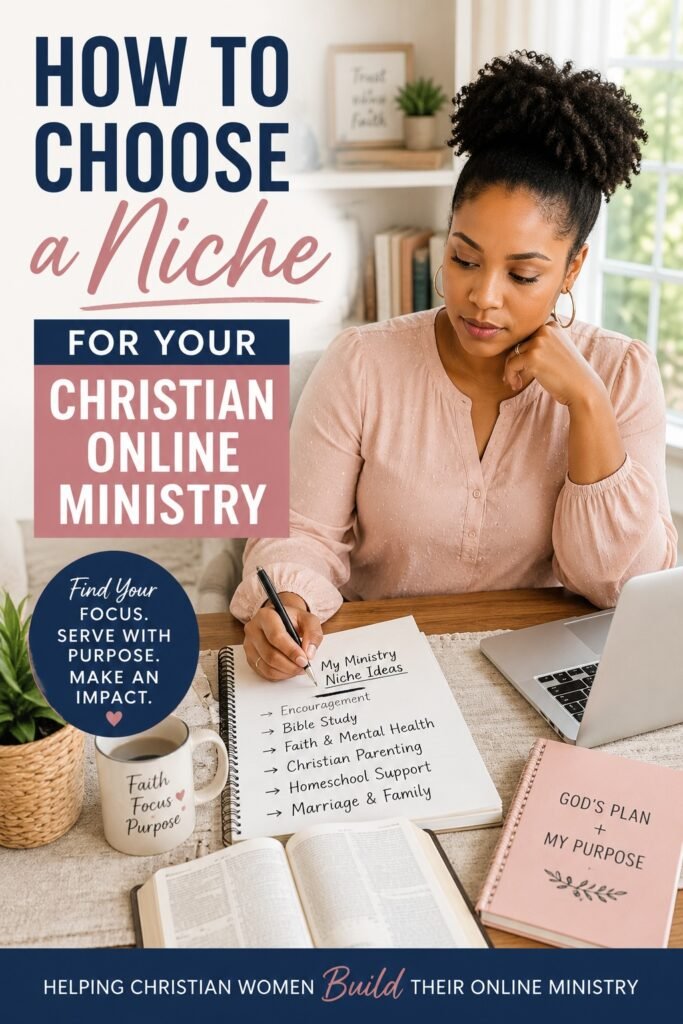
How to choose a niche for your Christian online ministry becomes much easier when you stop trying to serve everyone at once and begin identifying the specific people, needs, and biblical message God has placed on your heart.
You may feel called to encourage women, teach Scripture, strengthen families, or help believers through difficult seasons. Those desires matter. But they are still broad. A clear niche turns that general calling into a focused ministry direction your readers can understand.
Your niche does not place a limit on what God can do through your work. It simply helps you decide whom you are serving, what problems you will address, and what kind of content you should create first.
Quick Start: Complete this sentence: “I want to help Christian women who are struggling with ________ learn how to ________ through biblical truth and practical guidance.” Your first answer does not have to be perfect. It only needs to give you a clear starting point.
Ready to turn your ministry idea into a real website? Follow the Click-by-Click WordPress Faith Blog Builder for a simple, step-by-step path from choosing your direction to launching your Christian blog.
What Is a Christian Online Ministry Niche?
A niche is the focused area your ministry serves. It brings together three important elements:
- Your audience: the people you want to reach.
- Their need: the question, struggle, or goal bringing them to you.
- Your message: the biblical truth and practical help you will consistently share.
For example, “Christian women” is an audience, but it is not yet a complete niche. “Helping Christian mothers build peaceful family Bible routines” is much clearer. It tells you who the ministry serves, what they need, and what kind of content you should publish.
A focused niche also helps readers recognize that your website was created with them in mind. When a woman lands on your homepage, she should be able to think, “This is exactly the kind of help I have been looking for.”
Begin With the People You Feel Called to Serve
Before choosing a topic, think about the person behind it.
Who do you naturally notice? Whose struggles stay on your mind? Which women do you already find yourself encouraging at church, at work, in your family, or online?
You may feel especially drawn to:
- New Christian women learning how to study the Bible.
- Mothers trying to create faith-filled homes.
- Women recovering from grief, depression, or emotional exhaustion.
- Christian wives seeking biblical encouragement for marriage.
- Women who feel called to write, teach, coach, or create ministry resources.
- Believers trying to grow through prayer, fasting, or Scripture meditation.
Your own experiences can provide valuable insight. A season God brought you through may help you understand another woman’s questions with unusual compassion and clarity.
However, your niche does not have to be based entirely on your personal testimony. You may also choose an area you have studied deeply, served in faithfully, or feel led to explore with humility and care.
Identify the Specific Need You Want to Address
Once you know whom you want to serve, ask what she is trying to understand, overcome, build, or become.
“Christian parenting” is broad. “Helping mothers teach young children how to pray” is focused. “Mental health” is broad. “Biblical encouragement for Christian women living with anxiety” gives the ministry a clearer direction.
The more clearly you understand the reader’s need, the easier it becomes to plan articles, devotionals, email messages, printables, and future products.
Ask yourself:
- What question does she repeatedly search for?
- What makes her feel confused, discouraged, or stuck?
- What practical result does she hope to experience?
- What biblical truth would help her take the next step?
Your ministry does not have to solve every part of her life. It can serve one meaningful need well.
High-Demand Christian Online Ministry Niche Ideas
You do not need to chase trends, but you should consider whether people are actively seeking help in the area you want to cover. A ministry becomes easier to grow when your calling connects with a real and recognizable need.
Bible Study and Spiritual Growth
This niche can include verse-by-verse teaching, beginner Bible study methods, prayer, fasting, spiritual disciplines, Christian living, or devotional encouragement.
You might narrow it further by helping busy women study Scripture in short daily sessions or teaching new believers how to understand difficult Bible passages.
Christian Mental Health and Hard Seasons
This area may include biblical encouragement for anxiety, depression, grief, loneliness, trauma recovery, caregiver fatigue, or emotional burnout.
Write with compassion and appropriate boundaries. Spiritual encouragement can support readers, but it should not be presented as a replacement for licensed medical or mental health care when professional help is needed.
Christian Parenting and Family Discipleship
Parents often seek practical help with family prayer, children’s devotionals, biblical discipline, faith conversations, homeschooling, and creating Christ-centered household routines.
A focused ministry might serve mothers of young children, parents of teenagers, single Christian mothers, or families beginning home discipleship for the first time.
Marriage and Relationships
A marriage-focused ministry can address communication, prayer as a couple, conflict, forgiveness, intimacy, blended families, or supporting a spouse through difficult seasons.
Because relationship situations can be sensitive, your guidance should remain biblically grounded, responsible, and careful not to dismiss abuse or serious safety concerns.
Christian Homemaking
Christian homemaking can combine faith with routines, hospitality, meal planning, stewardship, home organization, family traditions, and creating a peaceful atmosphere.
This niche works best when the spiritual purpose remains clear. The goal is not merely a beautiful home, but a home shaped by service, wisdom, and love.
Christian Blogging and Digital Ministry
You may feel called to help other believers share their message online. Topics could include starting a Christian blog, writing devotionals, choosing hosting, building an email list, using Pinterest, creating digital products, or organizing an online ministry.
For a complete foundation, read How to Start a Christian Blog.
Choose a Niche That Gives You Room to Grow
A niche should provide focus without trapping your ministry inside one tiny topic.
For example, “30-day prayer challenges for newly married women” may be too narrow as the entire ministry identity. A broader direction such as “helping newly married Christian women build strong prayer lives and faith-filled homes” creates more possibilities.
Under that umbrella, you could write about prayer, marriage devotionals, Scripture habits, conflict, hospitality, and spiritual growth while still serving the same reader.
Think of your niche as a house. It should have clear walls, but enough rooms for your ministry to develop over time.
Test Your Niche Before Building Everything Around It
You do not need months of research before you begin. A simple test can reveal whether your niche has enough depth.
Try writing 20 article ideas for the audience you selected. If you struggle after five ideas, the niche may be too narrow or you may need to define the reader differently.
Then group your ideas into three to five content categories. A Christian mental health ministry, for example, might use:
- Biblical encouragement.
- Healthy coping practices.
- Prayer and Scripture resources.
- Personal testimony and hope.
- Guidance for seeking professional support.
You can also speak with several people who resemble your intended reader. Ask what they struggle with, what they search for, and what kind of support would genuinely help them.
Avoid Choosing a Niche for the Wrong Reasons
Do not choose a niche only because someone says it is profitable. Income may eventually support your ministry, but money alone rarely provides enough motivation to keep writing when growth is slow.
Also avoid selecting a subject simply because it is popular. If you have little interest, knowledge, or compassion for the people involved, that lack of connection will eventually show.
At the same time, do not wait for a dramatic sign before taking any action. Prayer, wisdom, experience, opportunity, and the needs you see around you can work together to provide direction.
You may gain greater clarity after publishing your first ten articles than you had before publishing your first one.
Why Your Ministry Needs a Self-Hosted Website
Social platforms can help people discover your message, but they should not be the only place your ministry lives.
When all your devotionals, teaching, and audience connections exist on a corporate platform, changes to policies, algorithms, account access, or content moderation can affect your ability to reach readers.
A self-hosted website gives you a ministry home base where you have greater control over your articles, email signup forms, downloadable resources, and long-term content library. It does not remove every possible risk, but it reduces your dependence on any single social network.
Use Pinterest, Facebook, Instagram, and other platforms as roads leading people toward your website—not as the only ground on which your ministry is built.
Your Step-by-Step Christian Ministry Niche Blueprint
- Pray for wisdom. Ask God to help you recognize both your calling and the people you are equipped to serve.
- Define your audience. Describe one specific type of reader rather than trying to reach everyone.
- Name her primary need. Identify the struggle, question, or goal your content will address.
- Clarify your message. Decide what biblical truth and practical guidance you will consistently offer.
- Write 20 content ideas. Make sure the niche has enough depth for sustained publishing.
- Create three to five categories. Organize your future content into clear ministry themes.
- Check room for growth. Choose a direction that can expand without losing its central audience.
- Build your website. Establish a self-hosted home for your articles and ministry resources.
- Publish and listen. Pay attention to the questions readers ask and the content they respond to.
- Refine with experience. Allow your niche to become clearer as your ministry develops.
Choose Clarity Over Perfection
You do not need the perfect niche before you begin. You need a faithful, understandable direction that helps you serve real people with meaningful content.
Choose an audience you care about. Identify a genuine need. Build your message around biblical truth, practical help, and the experience God has given you.
Your niche may become more refined over time, and that is not failure. It is part of learning how to serve well.
Ready to Build Your Christian Online Ministry?
A clear niche gives your ministry direction. Reliable hosting gives that ministry a secure online home where your content, resources, and audience can grow.
Compare these hosting options as you prepare to launch your self-hosted Christian website:
Choose your focus. Serve with purpose. Build a ministry home that can grow with your calling.