
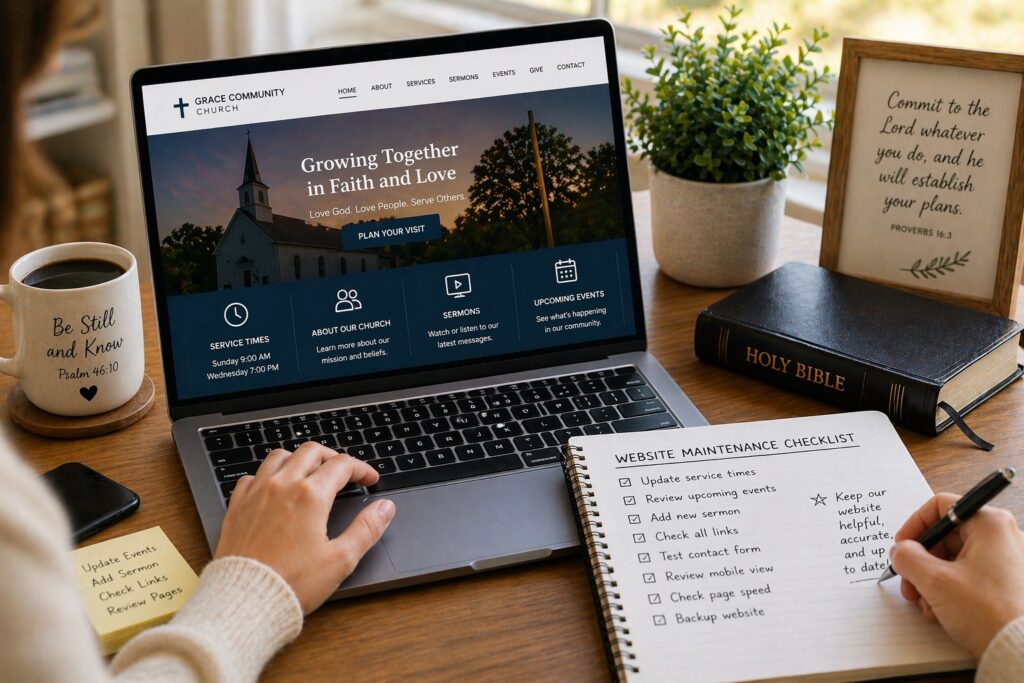
Some church websites start strong, but over time, they slowly become outdated not because the ministry has lost its heart, but because no clear system was in place to maintain it.
If you’re searching for Maintaining a Church Website Long Term, you’re likely realizing that building a website is only the beginning. The real challenge is keeping it accurate, useful, and aligned with your ministry over time.
Need help keeping your church website simple and steady?
Use the step by step guide to build a WordPress site that is easier to manage, update, and grow over time.
Start the Click by Click WordPress Faith Blog BuilderA website is not a one-time project. It is an ongoing part of your ministry. Once it is published, it still needs attention, care, and stewardship. A church website that stays current can serve visitors, members, leaders, and volunteers with clarity. But a church website that slowly becomes outdated can create confusion even if the ministry itself is active and faithful.
Why Long Term Maintenance Matters
A church website represents your ministry online. For many people, it is the first place they go before deciding whether to visit, listen to a sermon, attend an event, or reach out for prayer. That means the condition of the website shapes how people experience your church before they ever walk through the doors.
When the site is updated, clear, and reliable, it builds trust. Visitors feel more confident because the information looks current and useful. Members know where to find details. Volunteers can point people to accurate pages. The website becomes a helpful part of the ministry rhythm.
But when the site is outdated, broken, or confusing, it can create hesitation. People may wonder whether the service times are still correct, whether the church is still active, or whether the information can be trusted. That is why maintenance matters. It protects clarity and trust.
The Goal of Website Maintenance
The goal is not perfection. The goal is consistency.
You do not need to update your church website every day. You do not need to redesign it every few months. You simply need a steady rhythm that keeps key information accurate, important sections current, and basic functions working properly.
Consistency builds confidence. When visitors and members learn that your website is dependable, they are more likely to use it, share it, and return to it.
What Needs to Be Maintained
Church website maintenance becomes much easier when you know what actually needs attention. Instead of feeling overwhelmed by the whole site, focus on the main areas that affect trust, usability, and ministry communication.
1. Core Information
Always keep your service times, location details, and contact information updated. These are some of the most important details on the entire website.
If these are wrong, visitors may show up at the wrong time, go to the wrong place, or struggle to contact the church. That kind of confusion can be discouraging, especially for someone who is already nervous about visiting.
2. Event Updates
Your calendar should reflect current events. Remove past events, update recurring gatherings, and add upcoming activities as they are confirmed.
An outdated event calendar can make the church look inactive, even when ministry is happening every week. A current calendar helps people stay engaged and feel included in the life of the church.
3. Sermon Content
If your church shares sermons online, keep the sermon library updated and organized. New messages should be added consistently, and older sermons should be easy to find when possible.
This helps members stay connected if they miss a service. It also gives first-time visitors a way to understand your teaching before they attend in person.
4. Website Functionality
Check links, forms, buttons, menus, and embedded tools regularly. A broken contact form or a button that leads nowhere can create frustration quickly.
Functionality problems do not always announce themselves. That is why periodic checks matter. They help you catch small issues before they become larger problems.
5. Mobile Experience
Periodically review your website on a phone. Many people will visit from a mobile device, so your site needs to remain easy to read, easy to navigate, and easy to use on smaller screens.
Check whether pages load correctly, menus open smoothly, buttons are easy to tap, and text is readable without strain.
Creating a Simple Maintenance Rhythm
Maintenance becomes easier when it is part of a rhythm. You do not need a complicated system. You need a repeatable one.
Weekly Light Check
Each week, check the areas that change often. Add new sermons if your church publishes them. Update events if something has changed. Look for obvious issues on the homepage or main pages.
This does not need to take long. A short weekly check can prevent the site from drifting out of date.
Monthly Review
Once a month, review key pages such as the homepage, about page, service page, sermons page, events page, and contact page. Confirm that service details, location information, and contact options are still accurate.
This monthly review helps you keep the main structure trustworthy.
Quarterly Deeper Check
Every few months, take a deeper look at the whole website. Remove outdated content, simplify confusing sections, check page speed if needed, and look for places where the site could be clearer.
This does not mean rebuilding the website. It simply means making sure the site still serves the ministry well.
Who Should Manage the Website?
For many churches, website maintenance is handled by a volunteer, a staff member, or a small team. The exact person matters less than the clarity of responsibility.
Someone should know they are responsible for keeping the website current. They should have access to the site, understand the basic update process, and know who to ask when something needs a larger fix.
Without ownership, updates often stop. Everyone assumes someone else is handling it, and over time, the website begins to drift. Clear responsibility prevents that.
Keeping It Simple Over Time
One of the biggest reasons websites become outdated is complexity. If the site is too complicated, hard to update, or confusing to manage, it is much more likely to be neglected.
A simple structure is easier to maintain long term. Clear pages, simple navigation, manageable features, and a steady update rhythm all make the website more sustainable.
This is why the best long-term strategy is often not to keep adding more. It is to keep the site useful, focused, and easy to manage.
The Hidden Foundation of Maintenance
Maintenance is easier when your website foundation is strong. If your hosting is reliable, fast, and stable, there are fewer technical problems to manage. If your hosting is weak, you may face downtime, slow pages, broken experiences, and support headaches that make maintenance harder than it needs to be.
A strong foundation helps your website remain steady. It allows your team to focus on content updates and ministry communication instead of constant troubleshooting.
If you want to understand how a strong foundation supports long-term maintenance, you can explore this complete guide to church website hosting.
That page connects the broader church website system, while this post focuses on keeping the site useful over time.
Common Long Term Maintenance Mistakes
Letting Content Sit Too Long
Outdated information reduces trust. Even small outdated details can make visitors wonder whether the rest of the site is current.
Not Assigning Responsibility
If no one owns the website, it will usually become neglected. Someone needs to know that maintenance is part of their role.
Overcomplicating the Website
Complex sites are harder to manage over time. A simpler site that stays current is often better than a complicated site that slowly becomes outdated.
Ignoring Small Issues
Broken links, outdated event notices, slow pages, and form problems may seem small at first, but they can damage trust if left unresolved.
Simple Church Website Maintenance Checklist
- Are service times accurate?
- Are location and contact details current?
- Are events up to date?
- Are sermons current and organized?
- Are all important links working?
- Do contact forms submit properly?
- Is the site easy to use on mobile?
- Does someone clearly own website updates?
Bridging Maintenance and Ministry
Maintenance may not feel like ministry, but it supports ministry. It helps visitors feel confident, members stay informed, and your church remain accessible to the people looking for it.
A current website reflects care. It shows that your church is paying attention, that the information matters, and that people can rely on what they find. That kind of trust is valuable.
When your digital presence stays aligned with your real-life ministry, the website becomes a steady support system rather than a forgotten project.
Final Encouragement
Maintaining a Church Website Long Term is not about doing everything perfectly. It is about staying consistent.
Small, regular updates are far more effective than occasional large overhauls. Keep it simple. Stay steady. Focus on clarity. Let the website support the ministry instead of becoming a burden to it.
Because when your website stays current, your ministry stays accessible. And when your ministry stays accessible, more people can connect, participate, and be encouraged.
Ready to build a church website that stays useful over time?
Start with the step by step guide, then explore trusted hosting options that support stability, easier maintenance, and long term ministry growth.
Explore Hosting Picks:
About the Author
I’m Nehemiah Maxwell, a faith-driven writer and content strategist helping Christian women turn ministry ideas into thriving online platforms. Through WhichHostIsBest.com, I teach step-by-step hosting and WordPress strategies that make ministry setup simple so you can focus on what matters most: serving others with clarity and grace. I believe that when faith, clarity, and excellence come together, Kingdom impact multiplies. I’m also the author of If We Hold Fast: What Hebrews Reveals About Salvation, Endurance, and Eternal Security.