
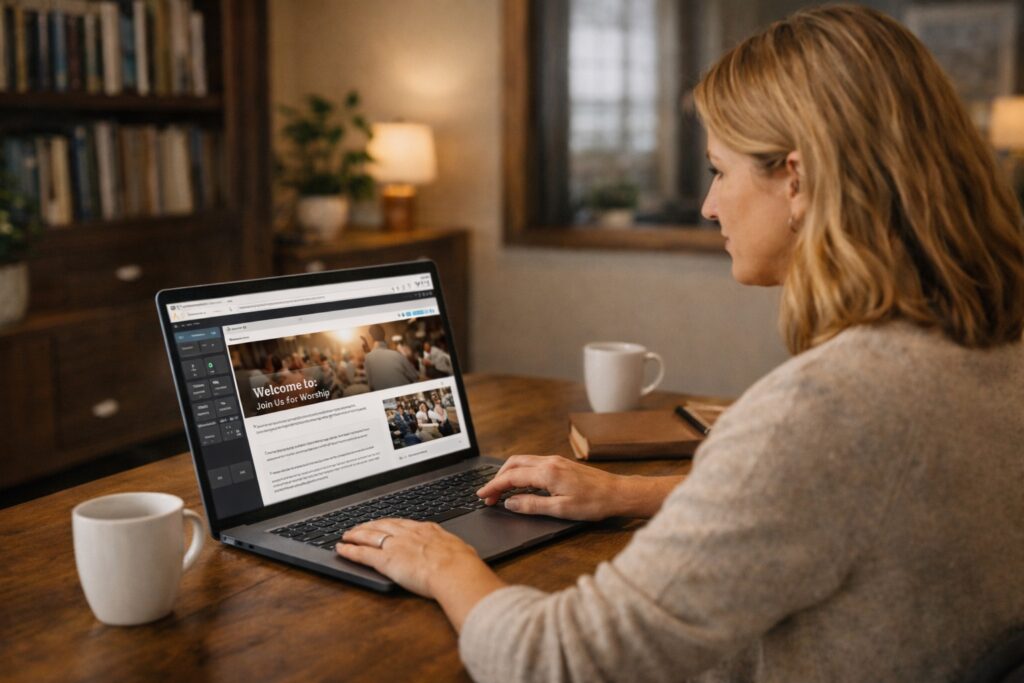
Somewhere right now, a church is ready to reach more people, but feels stuck because building a website seems harder than it should be.
If you’re searching for Website Builders for Churches, you’re likely looking for a simple, clear way to create a website without needing technical expertise. And that is exactly what the right website builder should provide: a way to focus on ministry, not mechanics.
Need help building your church website step by step?
Use the simple walkthrough that helps you set up your WordPress site with clarity, even if you are starting from scratch.
Start the Click by Click WordPress Faith Blog BuilderFor many churches, the website is not just an online flyer. It becomes a place where first-time visitors learn what to expect, current members stay informed, and people in difficult seasons quietly look for hope. That is why the builder you choose matters. It shapes how easily your church can create, update, and grow its online presence over time.
Why Website Builders Matter for Churches
Not every church has a web developer, a communications team, or a staff member with technical training. In many ministries, the website is managed by a pastor, church secretary, volunteer, or faithful member who is doing the best they can with limited time.
A website builder helps remove those barriers. It gives you a way to create and manage pages visually instead of writing code. That means you can update service times, add sermon information, publish event announcements, and keep your website current without turning every small edit into a complicated task.
For churches, that kind of simplicity matters because consistency matters. A website that is easy to manage is far more likely to stay updated and useful to the people who visit it.
The Real Goal Is Simplicity Without Limitation
It is easy to assume that the best choice is simply the easiest builder you can find. But for churches, the better goal is to find something that is simple to start and strong enough to grow.
Your church may begin with only a few basic needs:
- A homepage
- Service times and location
- Contact information
- A short statement about your ministry
But over time, your website may need more:
- Sermon archives
- Event calendars
- Ministry pages
- Volunteer forms
- Online giving tools
- Prayer request forms
The best builder is one that supports both your starting point and your future growth.
The Three Main Types of Website Builders
Understanding the main categories will make the decision much easier.
1. All In One Builders
These platforms bundle together hosting, design tools, and templates in one place. They are usually easy to begin with because much of the setup is handled for you.
They often appeal to churches that want a fast start and a very simple editing experience. For very small ministries with minimal needs, they can work reasonably well.
But there is often a tradeoff. While these builders are easy at the beginning, they may become restrictive later if your church wants deeper flexibility, stronger customization, or more advanced ministry features.
2. WordPress Based Builders
This is the path many strong church websites eventually choose. In this setup, WordPress serves as the website platform, and a visual builder such as Elementor helps you design and edit pages more easily.
This approach often gives churches the best balance of usability and long term flexibility. You can start simple, but you are not boxed in if your needs expand. That makes WordPress especially attractive for ministries that want to build something sustainable rather than temporary.
3. Custom Built Websites
These are developed from scratch by a designer or developer. They can be tailored very specifically to a church’s vision, but they are often far more expensive and harder to manage without outside help.
For most churches, especially those just beginning, a custom site is usually more than what is necessary.
Why Many Churches Eventually Choose WordPress
There is a reason WordPress continues to be a strong option for churches. It gives ministries room to grow without forcing them to start over later.
With WordPress, you can begin with a simple website and then gradually add what you need. You can expand your sermon section, create pages for ministries, include event tools, and improve design over time. That kind of flexibility is valuable for churches because ministry needs often change as the church grows, adapts, and reaches new people.
WordPress also has wide support, which means you are less likely to feel stuck inside a closed system. That is important when stewardship and long term sustainability matter.
The Hidden Connection Most Churches Miss
A website builder does not stand alone. It depends on the foundation underneath it. That foundation is hosting.
Even the most attractive builder will become frustrating if the website loads slowly, goes down often, or struggles to handle basic traffic. That is why the builder decision and the hosting decision work together.
If you want to see how this connects to the larger picture of church website planning, you can explore this complete guide to church website hosting.
That anchor page is designed to connect the full lane together, while this article helps you understand the builder side of the decision more clearly.
What to Look for in a Church Website Builder
Ease of Use
You should be able to add pages, edit text, upload images, and make changes without feeling confused every time you log in. A builder should reduce friction, not create more of it.
Mobile Friendly Design
Many people will visit your church website from a phone. The builder you choose should make it easy for your site to look clean and readable on smaller screens.
Templates That Fit Ministry Needs
Good templates help you launch faster. Look for layouts that naturally support church essentials such as service information, about pages, ministries, sermons, and event announcements.
Integration Options
As your church grows online, you may want to connect email tools, donation systems, event calendars, or sermon media. A good builder should leave room for those additions.
Support and Stability
If something breaks or you get stuck, dependable support matters. It is better to have a stable system with helpful support than a flashy system that leaves you stranded when you need help most.
Common Mistakes Churches Should Avoid
Choosing Based Only on Looks
A builder can look impressive in a demo and still become difficult to manage in real life. What matters is not just how the site looks on day one, but how manageable it remains month after month.
Ignoring Long Term Growth
Think beyond the current season. Ask yourself whether this builder will still serve your church well a year from now if your content, ministries, or online activity increase.
Trying to Build Everything at Once
Some churches get stuck because they imagine they need a huge website before launching. In most cases, that is not necessary. It is better to begin with a solid core and build gradually than to delay endlessly waiting for perfection.
Simple Church Website Builder Checklist
- Can I update the website myself without technical stress?
- Will the site look good on phones and tablets?
- Can this platform grow with our church over time?
- Does it connect with tools we may need later?
- Is there dependable support if we get stuck?
Bridging Vision Into Action
Many churches know they need a website but delay moving forward because the process feels complicated. A good website builder helps close that gap. It turns a vague desire into a practical next step.
That matters because a church website becomes more than an online presence. It becomes a front door for visitors, a connection point for members, and a place where people can learn, listen, and reach out. The right builder makes that possible without placing unnecessary strain on the people serving behind the scenes.
Final Encouragement
Choosing the right Website Builders for Churches is not about finding the most advanced tool on the market. It is about finding a path that allows your church to begin with clarity, confidence, and purpose.
You do not need to be highly technical. You do not need to build everything in a week. You simply need a builder that makes it easier to serve people well online and a foundation that supports your ministry as it grows.
When that foundation is in place, your website becomes more than a project. It becomes a practical extension of your church’s mission, helping people find your ministry and connect with truth when they need it most.
Ready to build a church website that can grow with your ministry?
Start with the step by step guide, then explore trusted hosting options that support flexibility, stability, and long term ministry growth.
Explore Hosting Picks:
About the Author
I’m Nehemiah Maxwell, a faith-driven writer and content strategist helping Christian women turn ministry ideas into thriving online platforms. Through WhichHostIsBest.com, I teach step-by-step hosting and WordPress strategies that make ministry setup simple so you can focus on what matters most: serving others with clarity and grace. I believe that when faith, clarity, and excellence come together, Kingdom impact multiplies. I’m also the author of If We Hold Fast: What Hebrews Reveals About Salvation, Endurance, and Eternal Security.