
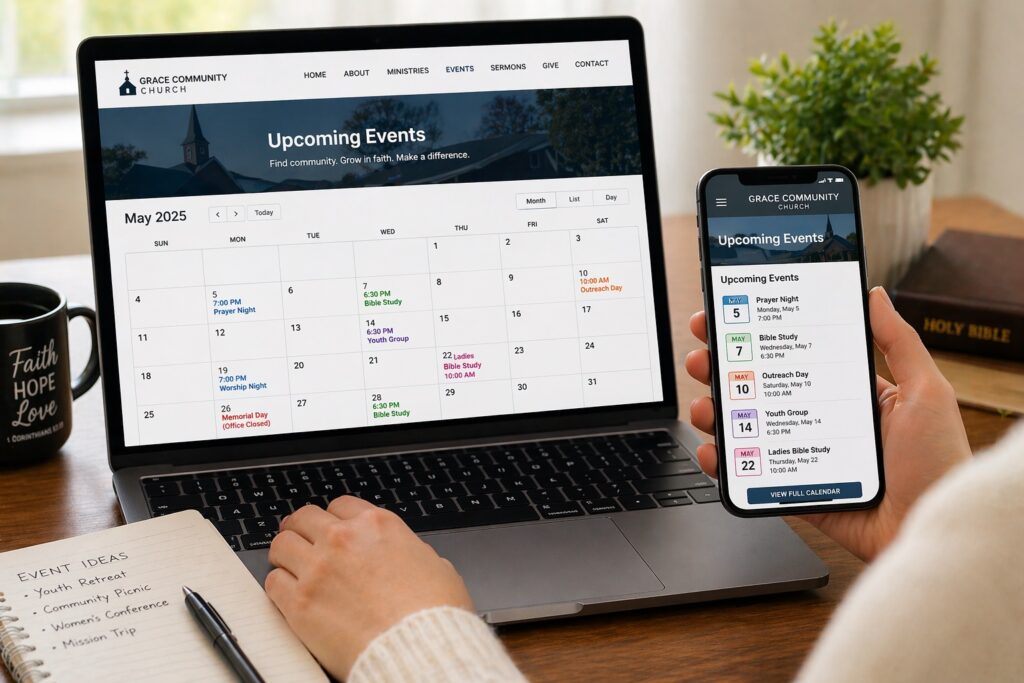
There are people who want to attend, connect, and participate, but if they cannot clearly see what is happening and when, they often miss the opportunity entirely.
If you’re searching for Church Event Calendar Website Setup, you’re likely looking for a way to organize and display your church events so people can easily stay informed and involved. This is not just about listing dates. It is about helping people take part in the life of your ministry.
Need help building your church website step by step?
Use the simple walkthrough that helps you set up your WordPress site with clarity, even if you are starting from scratch.
Start the Click by Click WordPress Faith Blog BuilderAn event calendar turns information into action. When done well, it quietly helps your church stay connected, organized, and easy to engage with. It gives members, visitors, families, volunteers, and ministry leaders one central place to see what is happening and decide how to participate.
Why an Event Calendar Matters for Churches
Church life often includes far more than Sunday services. There may be Bible studies, prayer meetings, youth gatherings, outreach events, ministry trainings, special services, volunteer meetings, and community activities throughout the month.
Without a clear system, those events can become scattered. Some details may be shared from the pulpit, others may appear in a bulletin, and others may be mentioned in a text message or social media post. That can work for people who are already deeply connected, but it can be confusing for visitors, newer members, and busy families.
An event calendar creates a central place where people can see what is happening, plan ahead, and stay engaged. It removes confusion and replaces it with clarity.
What a Church Event Calendar Should Do
A church event calendar does not need to be complicated. It simply needs to answer the questions people naturally ask before participating.
- What is happening?
- When is it happening?
- Where is it happening?
- Who is it for?
- How do I participate?
If your calendar answers those questions clearly, it is doing its job well. The goal is not to impress people with design complexity. The goal is to make participation easier.
Key Elements of a Strong Event Calendar
Before choosing tools or layouts, it helps to understand the content your calendar should include. A strong calendar depends on clear information.
1. Clear Event Titles
Each event should have a simple, descriptive name. Instead of vague titles, use wording that helps people understand what the event is immediately.
Examples include:
- Wednesday Night Bible Study
- Youth Group Gathering
- Community Outreach Day
- Women’s Prayer Breakfast
- New Members Class
Clear titles help people recognize the purpose of an event quickly, especially when they are scanning from a phone.
2. Dates and Times
This may seem obvious, but dates and times must be clear and easy to read. Avoid confusing formats or missing details. If an event repeats weekly or monthly, make that clear too.
People should not have to wonder whether an event is happening this week, next week, or every week. The calendar should answer that plainly.
3. Location Details
Include the address when needed, but also include room or building details if your church campus has multiple spaces. A visitor may not know where the fellowship hall is. A newer family may not know where the youth room is located.
Good location details remove uncertainty and help people feel more comfortable attending.
4. Short Descriptions
A brief description helps people decide whether to attend. You do not need a long explanation. A few clear sentences are often enough.
A useful description can explain what the event is, who it is for, what to expect, and whether registration is needed.
5. Easy Navigation
Your calendar should be easy to browse. People should be able to scroll through upcoming events, view key details, and find what matters to them without frustration.
If the calendar feels cluttered or confusing, fewer people will use it even if the information is technically there.
Types of Event Calendar Layouts
Different churches use different calendar layouts depending on their size, event rhythm, and website structure. Most churches benefit from using a simple format that matches how their people actually look for information.
Monthly Calendar View
A monthly calendar view shows events in a grid. This can be helpful for seeing the full month at a glance. It works especially well for churches with many recurring events or multiple ministry activities throughout the week.
List View
A list view displays events in a vertical format. This is often easier to read on mobile devices and helps visitors quickly scan upcoming activities. For many churches, this is one of the most practical layouts.
Featured Events Section
A featured events section highlights key upcoming gatherings. This can be useful for special services, outreach events, conferences, or important ministry moments that need extra visibility.
Many churches use a combination of these approaches: a simple event list for everyday browsing and featured event blocks for major announcements.
Why Simplicity Matters
It can be tempting to add many categories, filters, colors, and design elements to your event calendar. But complexity does not always make a calendar more useful.
A simple calendar is often easier to manage, easier to update, and easier for visitors to understand. It usually loads faster and creates less friction for people who just want to know what is happening.
Clarity always wins. If people can quickly find the next event, understand the details, and know how to participate, your calendar is serving its purpose.
Mobile Friendly Calendars Are Essential
Many people will check your church event calendar from a phone. They may be sitting in the car, talking with a spouse, planning the week, or checking details right before leaving home.
Your calendar should display cleanly on small screens, be easy to scroll, and make event details simple to open. Buttons should be easy to tap. Text should be readable. Important details should not be hidden inside hard-to-use layouts.
If your event calendar is difficult to use on mobile, many people may stop using it altogether.
Connecting Your Calendar to Your Website
Your event calendar should not be hidden. It should be easy to find from the main menu, linked from the homepage when appropriate, and updated regularly so people learn to trust it.
When a calendar is current and visible, people begin to rely on it. When it is outdated or hard to find, they stop checking it.
That consistency matters because your calendar is not just a page. It is part of how your church communicates.
The Hidden Foundation Behind Event Calendars
Even though a calendar is a feature, it depends on your website’s foundation. If your site is slow, unstable, or difficult to navigate, people may not stay long enough to use the calendar. If the calendar page takes too long to load, the experience can become frustrating.
That is why hosting and structure still matter. Your calendar sits on top of the foundation your website provides.
If you want to understand how your website foundation supports everything, including your event calendar, you can explore this complete guide to church website hosting.
That page connects the broader church website system, while this post focuses on the event calendar setup layer.
Common Mistakes Churches Make
Not Updating Events Regularly
Outdated calendars create confusion and reduce trust. If visitors see old events, they may wonder whether the church website is still being maintained.
Providing Too Little Information
Missing details make people unsure about attending. A title alone is often not enough. Include the basics so people know what to expect.
Overcomplicating the Layout
Too many categories, colors, and filters can overwhelm visitors. A clean layout is often better than a complicated one.
Hiding the Calendar
If people cannot find the calendar easily, it will not be used. Make it visible and accessible from logical places on the website.
Simple Event Calendar Checklist
- Are events clearly titled?
- Are dates and times easy to understand?
- Is the location included?
- Are short descriptions provided?
- Is the calendar easy to navigate?
- Does it work well on mobile?
- Is it updated regularly?
Bridging Events and Ministry Life
Events are part of how people connect. They create opportunities for fellowship, growth, service, outreach, and community. But people can only participate in what they can clearly see and understand.
Your event calendar helps make those opportunities visible. Without it, people may miss what your church is doing. With it, they can participate more easily and feel more connected to the rhythm of ministry life.
Final Encouragement
Setting up a Church Event Calendar Website Setup is not about building something complex. It is about creating clarity.
Start simple. Keep it updated. Make it easy to use. Focus on helping people know what is happening and how they can take part.
Because when people can clearly see what is happening, they are far more likely to participate. And when people participate, your ministry becomes more connected, active, and engaged.
Ready to build a church website that keeps people informed and connected?
Start with the step by step guide, then explore trusted hosting options that support event calendars, useful features, and long term ministry growth.
Explore Hosting Picks:
About the Author
I’m Nehemiah Maxwell, a faith-driven writer and content strategist helping Christian women turn ministry ideas into thriving online platforms. Through WhichHostIsBest.com, I teach step-by-step hosting and WordPress strategies that make ministry setup simple so you can focus on what matters most: serving others with clarity and grace. I believe that when faith, clarity, and excellence come together, Kingdom impact multiplies. I’m also the author of If We Hold Fast: What Hebrews Reveals About Salvation, Endurance, and Eternal Security.