
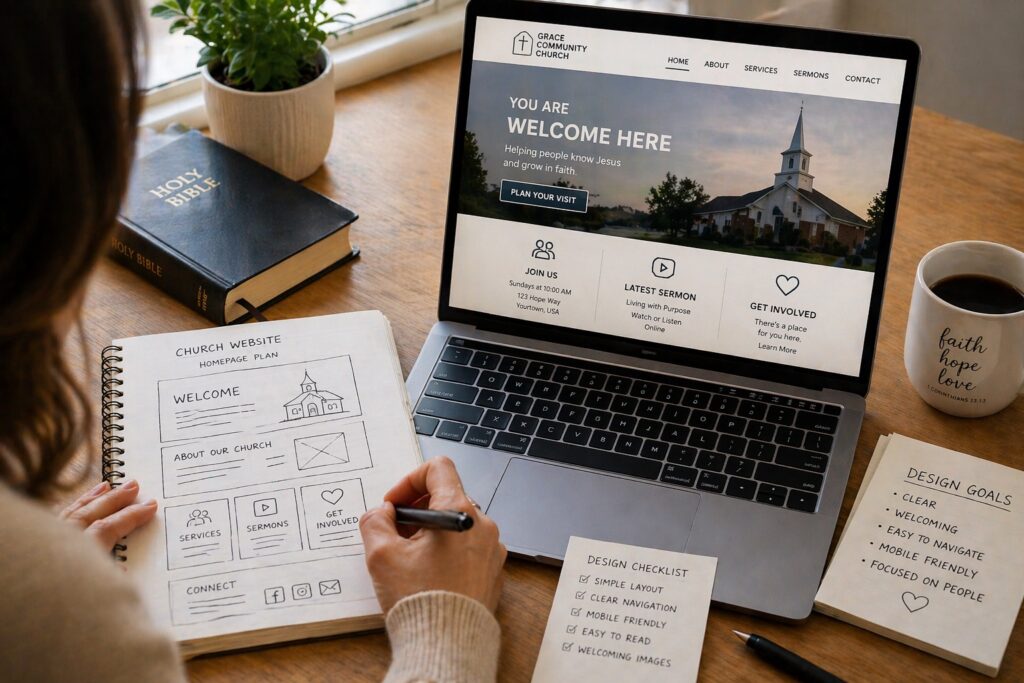
When someone visits a church website for the first time, they are not just looking at colors and layouts. They are quietly deciding whether they feel welcomed, understood, and safe enough to take the next step.
If you’re searching for Church Website Design Best Practices, you’re not simply trying to make a website look better. You’re trying to create an online space that reflects your church’s heart, communicates clearly, and helps people connect without confusion.
Need help building your church website step by step?
Use the simple walkthrough that helps you set up your WordPress site with clarity, even if you are starting from scratch.
Start the Click by Click WordPress Faith Blog BuilderDesign is not just about appearance. For churches, design shapes how people experience your ministry before they ever attend a service, speak to a greeter, or hear a sermon in person. In many cases, your website becomes the first introduction to your church, which means its design communicates something long before your words do.
Why Church Website Design Matters More Than Many People Realize
A church website often serves people at meaningful moments. Someone may be looking for a church to visit this Sunday. Someone else may be searching late at night for hope, prayer, or a place to belong. In those moments, the design of your website influences whether they feel invited to stay or overwhelmed enough to leave.
Good design helps people feel at ease. It helps them find important information quickly. It builds trust by showing that your ministry is clear, thoughtful, and prepared to serve. Poor design, on the other hand, can create confusion, friction, and frustration even if your message is strong.
That is why design is not decoration. It is communication.
The Main Goal of Church Website Design
The goal of church website design is not to impress people with complexity. The goal is to guide people with clarity.
A well-designed church website should help visitors understand who you are, when you meet, where you are located, and how they can take a next step. It should remove confusion instead of adding to it. That means the design should feel simple, organized, and welcoming rather than crowded or overly clever.
Think of your website as a path, not a performance. A path helps people move forward. A performance may look impressive, but it does not always help people know where to go next.
Simplicity Is One of the Strongest Design Principles
Many churches feel pressure to include everything on the homepage. They want every ministry, every announcement, every event, and every detail to be visible all at once. But too much information in one place often creates the opposite of what is intended.
Instead of helping people, it overwhelms them.
Simplicity creates space. It helps visitors focus on what matters most. It makes your site feel easier to use and more welcoming to explore. That does not mean your site needs to feel empty. It means every section should have a purpose and every element should help the visitor, not compete for attention.
Clear Navigation Builds Immediate Trust
If someone arrives on your church website, they should not have to guess where to click. Good navigation helps people find key information within seconds.
For most churches, the main menu should stay simple and clear. Common items often include:
- Home
- About
- Visit Us or Services
- Sermons
- Contact
That kind of structure works because it reflects what most visitors are actually looking for. It is usually better to use familiar labels than to get creative with menu titles that sound clever but leave people confused.
If you are building the larger structure of your church website and want to understand how design fits into the full system, you can explore this complete guide to church website hosting.
That anchor page helps connect the bigger picture, while this article focuses specifically on design best practices.
Mobile Friendly Design Is Essential
Many visitors will see your website on a phone before they ever see it on a desktop computer. That means mobile design is no longer optional.
Your site should be easy to read on smaller screens. Buttons should be easy to tap. Text should not feel cramped. Menus should be easy to access. If the mobile version of your site feels awkward or difficult to use, many visitors will leave before they ever learn anything about your church.
Good mobile design is not just a technical upgrade. It is part of serving people well.
Your Homepage Should Answer the Most Important Questions Fast
When someone lands on your homepage, they should quickly understand the basics:
- What kind of church is this?
- When are the services?
- Where is it located?
- How can I learn more or get in touch?
Your homepage does not need long explanations to do that well. Clear headings, concise text, and well-placed sections often do more than large paragraphs. Visitors are usually scanning before they are deeply reading. Good design respects that behavior and makes the key information visible right away.
Use Images That Feel Real and Welcoming
Images shape emotion quickly. They help people sense the tone of your church before they read a single sentence. That is why the photos on your website matter.
Use images that feel natural, warm, and relevant to real ministry life. Show genuine moments when possible. Avoid visuals that feel overly staged, distracting, or disconnected from the actual experience of your church. People are not looking for perfection. They are looking for authenticity.
Strong images do not replace clear communication, but they can support it in a meaningful way.
Readable Text Matters More Than Fancy Styling
One of the easiest ways to weaken a website is to make the text hard to read. Fancy fonts, weak contrast, tiny text, and large unbroken paragraphs all create friction for visitors.
Good readability usually comes from simple choices:
- Use clean fonts
- Keep spacing comfortable
- Break ideas into shorter paragraphs
- Use headings to guide the eye
Readable text makes your message easier to receive. Since your website exists to communicate, this matters greatly.
Consistency Helps Your Website Feel Trustworthy
When a website uses too many different colors, fonts, styles, or layout patterns, it can begin to feel chaotic. Even if visitors cannot explain why, they often sense when a site feels inconsistent.
Consistency helps your website feel stable and thoughtful. When colors, fonts, spacing, and page structures work together, the site feels more trustworthy. This does not require advanced design skill. It simply requires restraint and intentionality.
Design Should Support the Message, Not Compete with It
It is easy to become so focused on making a website look good that you lose sight of why it exists. Your church website is there to welcome people, communicate clearly, and help them move toward connection. Design should support that mission, not overshadow it.
When design becomes too busy, too clever, or too focused on visual effects, it can distract from the very message the site is meant to carry. Clear design keeps the focus where it belongs.
Common Design Mistakes Churches Should Avoid
Overloading the Homepage
Trying to display everything at once usually creates confusion. It is better to guide people through clear sections than to crowd the page with too many competing elements.
Using Too Many Colors
A crowded color palette can make the site feel noisy and unsettled. Simpler color choices usually lead to a calmer and more welcoming experience.
Ignoring Mobile Users
If your website works well on desktop but not on phone screens, many visitors will never get far enough to benefit from your content.
Hiding Important Information
Service times, location, and contact details should not be difficult to find. Visitors often decide quickly whether they can trust and use a site based on how easily they can locate those basics.
Simple Church Website Design Checklist
- Is the site easy to navigate?
- Can visitors find service times quickly?
- Does the site work well on mobile?
- Is the design clean and uncluttered?
- Do the images feel real and welcoming?
- Is the text easy to read?
How Design and Ministry Work Together
Design affects how people experience your church before they ever step through the door. A clear and welcoming website can reduce hesitation, answer questions, and help someone feel comfortable enough to visit. That is not a small thing. It is part of hospitality in digital form.
In that sense, thoughtful design becomes part of ministry support. It helps remove barriers and make the next step feel easier for the people you hope to serve.
Final Encouragement
Following Church Website Design Best Practices is not about building something flashy or perfect. It is about building something clear, welcoming, and useful.
You do not need advanced design training to do that well. You simply need to keep things simple, focus on clarity, and remember the person on the other side of the screen.
When your church website is easy to use and easy to understand, it becomes more than a design project. It becomes a doorway, and for someone searching in the right moment, that doorway may make all the difference.
Ready to build a church website that feels clear, welcoming, and easy to use?
Start with the step by step guide, then explore trusted hosting options that support strong design, better user experience, and long term ministry growth.
Explore Hosting Picks:
About the Author
I’m Nehemiah Maxwell, a faith-driven writer and content strategist helping Christian women turn ministry ideas into thriving online platforms. Through WhichHostIsBest.com, I teach step-by-step hosting and WordPress strategies that make ministry setup simple so you can focus on what matters most: serving others with clarity and grace. I believe that when faith, clarity, and excellence come together, Kingdom impact multiplies. I’m also the author of If We Hold Fast: What Hebrews Reveals About Salvation, Endurance, and Eternal Security.