
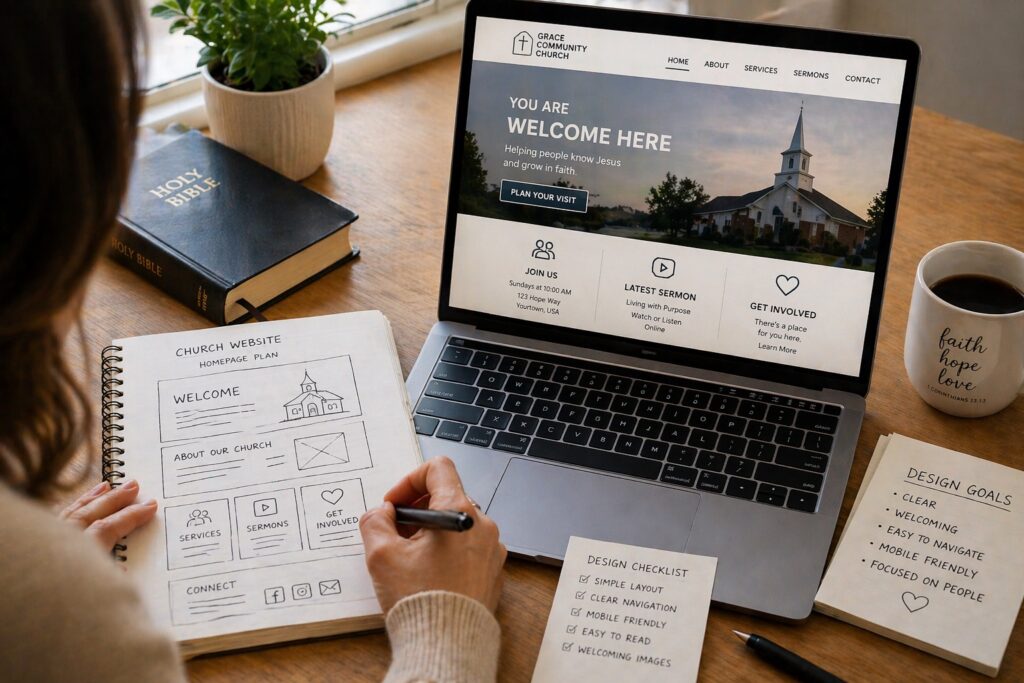
Sometimes the difference between a website that simply exists and one that truly serves people is not how it looks, but what it allows people to do when they arrive.
If you’re searching for Church Website Features Every Ministry Needs, you’re likely trying to understand what actually belongs on a church website. Not just what looks good, but what helps people connect, engage, and take meaningful next steps.
Need help building your church website step by step?
Use the simple walkthrough that helps you set up your WordPress site with clarity, even if you are starting from scratch.
Start the Click by Click WordPress Faith Blog BuilderA church website is not just information. It is interaction. And the right features can make the difference between a visitor who leaves confused and one who feels ready to connect. That is why the feature layer of a church website matters so much. Features are what turn a site from something passive into something useful, welcoming, and practical for real ministry life.
Why Features Matter More Than Design Alone
Design helps people feel comfortable when they first land on your website. It shapes first impressions and helps your church appear clear and welcoming. But features help people do something once they arrive.
A beautiful website may create a good impression, but if visitors cannot find service times, contact the church, listen to sermons, or learn how to take the next step, that good impression will only go so far. Features give your website usefulness. They provide clear paths that move people from curiosity to connection.
Without those paths, even a well-designed church website can feel incomplete.
The Main Purpose of Church Website Features
Every feature on your site should answer a simple question: what is this helping someone do?
For example:
- Service times help people plan a visit
- Contact forms help people ask questions
- Sermon pages help people hear your message
- Event calendars help people stay informed
When a feature serves a real purpose, it strengthens your website. When it does not, it usually adds clutter. That is why the goal is not to have the most features. The goal is to have the right features.
Essential Features Every Church Website Should Have
Some features belong on almost every church website, regardless of size. These are the practical basics that help visitors understand your church and engage with it more easily.
1. Clear Service Information
This is one of the most important features on your website. People should be able to find service times, location details, directions, and basic visit information quickly.
Many churches accidentally bury this information deep in the site, but it should be visible from the homepage or main navigation. If visitors have to search too hard for service details, some of them will leave before ever taking the first step toward visiting.
2. Contact and Connection Forms
Not everyone is ready to call a church office or send a direct email. A simple contact form gives people a low-pressure way to reach out. It can help visitors ask questions, request prayer, learn more about the church, or follow up after a visit.
This matters because it creates an easy starting point for relationship. For some people, that small step is the beginning of something much deeper.
3. Sermon Access
Many people want to hear a message before attending in person. That is why sermon access is such a valuable feature. Your site can include recent sermons, audio messages, video sermons, or archived message series.
This helps first-time visitors become familiar with your church’s teaching. It also serves current members who may have missed a service or want to revisit a message later in the week.
4. Event Calendar or Events Section
Church life often involves more than Sunday services. There may be Bible studies, prayer meetings, youth events, outreach gatherings, and special services throughout the month.
An event calendar or event section helps people stay informed and involved. Without it, updates can feel scattered or easy to miss. As a church grows, this feature becomes even more useful because ministry activity expands beyond one weekly gathering.
5. About Page with Clear Identity
People do not just want to know when you meet. They want to know who you are. A strong about page helps answer important questions such as what the church believes, what kind of church it is, what a visitor should expect, and what the mission of the ministry is.
This builds confidence and helps reduce uncertainty before someone ever steps through the door.
6. Mobile Friendly Functionality
This is not optional anymore. Most people will visit your church website on a phone, not a desktop computer. That means your features must work well on mobile.
Visitors should be able to tap buttons easily, read text clearly, open menus smoothly, and submit forms without frustration. A feature that only works well on desktop is not really serving most of your visitors.
7. Simple and Clear Navigation
Features only help people if they can find them. That is why navigation matters so much. Your main menu should guide visitors clearly to the most important parts of the site without overwhelming them.
Simple navigation often includes pages like Home, About, Visit Us or Services, Sermons, Events, and Contact. Too many menu items can create confusion. A shorter and clearer navigation usually serves people better.
High Impact Features for Growing Ministries
Once the core features are in place, additional features can help growing churches serve people even better.
Online Giving
Online giving makes it easier for people to support your ministry securely and consistently. For many churches, this becomes an essential feature over time because it meets people where they already are and removes friction from the giving process.
Volunteer Sign Up Forms
This feature helps members get involved in practical ways. It creates a clear path for serving in ministries, events, outreach, or church life. Instead of hoping people ask how to help, the website gives them a direct way to respond.
Email Signup
An email signup form helps visitors and members stay connected. It allows your church to send announcements, encouragement, event reminders, and ministry updates. This can become an important bridge between your website and ongoing communication.
Prayer Request Forms
This is one of the most ministry-centered features a church website can include. A prayer request form gives people a way to reach out when they are hurting, overwhelmed, or looking for support. That turns a website from a simple information tool into a real point of care.
Features Should Support, Not Overwhelm
One of the biggest mistakes churches make is assuming they need everything at once. But too many features can create slower load times, visual clutter, more maintenance, and greater confusion for visitors.
It is usually wiser to start with the essential features and then add more only when they serve a real purpose. A simple website with the right features is often far more effective than a complicated website with too many moving parts.
The Hidden Foundation Behind Every Feature
Every feature depends on the strength of your website foundation.
If your hosting is weak:
- Pages may load slowly
- Forms may fail
- Sermons may buffer poorly
- Event pages may become frustrating to use
That is why features and hosting are connected.
If you want to understand how the foundation supports everything else on your church website, you can explore this complete guide to church website hosting.
That page helps connect the broader structure, while this post focuses specifically on the feature layer of the lane.
Common Mistakes Churches Make with Website Features
Adding Too Much Too Soon
When a church tries to launch with every possible feature, the site often becomes harder to manage and less clear for visitors.
Ignoring Mobile Performance
A feature that looks fine on desktop but works poorly on phones creates friction for a large percentage of visitors.
Failing to Test Key Functions
Broken forms, outdated event links, or sermon pages that do not load can quickly reduce trust.
Prioritizing Extras Over Essentials
A website does not need flashy tools before it has the basics in place. Clear service information, contact options, and sermon access matter more than fancy extras.
Simple Feature Checklist for Churches
- Can visitors find service times quickly?
- Can they contact the church easily?
- Can they listen to recent sermons?
- Can they stay informed about events?
- Does the website work well on mobile?
- Is the navigation simple and clear?
Bridging Features and Ministry
Features are not just technical tools.
They are pathways.
They help people:
- Take a first step
- Ask for help
- Learn about your church
- Stay connected
- Respond to opportunities
Without the right features, a website can remain passive.
With the right features, it becomes active and useful.
That is where ministry support really begins to show online.
Final Encouragement
Understanding Church Website Features Every Ministry Needs is not about creating the most advanced site possible.
It is about creating a website that helps people connect clearly and easily.
Start with the essentials.
Focus on usefulness.
Add more features only when they serve a real purpose.
Because when your website makes it easy for people to connect, your ministry becomes easier to access.
And when your ministry is easier to access, more people can be welcomed, encouraged, and served.
Ready to build a church website that truly helps people connect?
Start with the step by step guide, then explore trusted hosting options that support useful features, smooth user experience, and long term ministry growth.
Explore Hosting Picks:
About the Author
I’m Nehemiah Maxwell, a faith-driven writer and content strategist helping Christian women turn ministry ideas into thriving online platforms. Through WhichHostIsBest.com, I teach step-by-step hosting and WordPress strategies that make ministry setup simple so you can focus on what matters most: serving others with clarity and grace. I believe that when faith, clarity, and excellence come together, Kingdom impact multiplies. I’m also the author of If We Hold Fast: What Hebrews Reveals About Salvation, Endurance, and Eternal Security.