
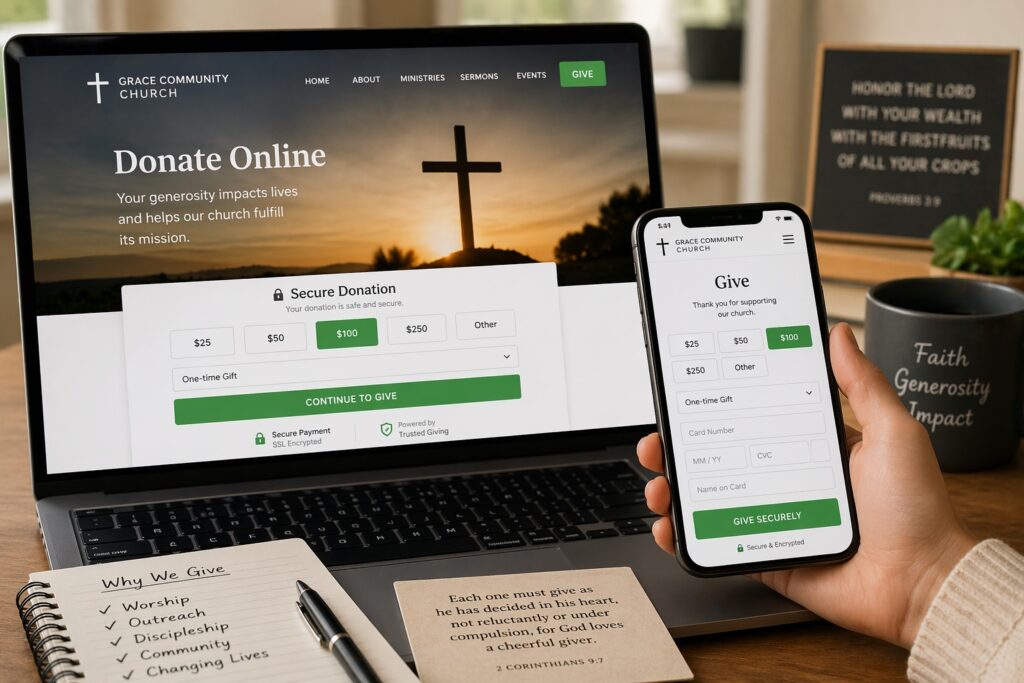
Choosing an online giving platform for your church can feel surprisingly complicated. Nearly every company promises simple giving, better engagement, and easier administration. The real question is: which one actually fits your church?
If you’re comparing online giving platforms for churches, the best choice usually isn’t the platform with the longest feature list. It’s the one that makes giving easy for your congregation while making donations, records, reporting, and recurring gifts manageable for the people working behind the scenes.
This guide will help you compare several well-known church giving platforms, understand the differences that actually matter, and narrow your options without getting buried in technical details.
Quick answer:
There is no single best online giving platform for every church. A smaller church may value simplicity and low overhead, while a growing or multi-campus church may care more about donor management, reporting, church-management integration, mobile apps, and administrative tools. Start with what your church actually needs, then compare platforms around those needs.
What Is an Online Giving Platform for Churches?
An online giving platform allows people to support your church electronically instead of relying only on cash or checks during a service.
Depending on the platform, your congregation may be able to give through your church website, a mobile-friendly giving form, an app, a text message, a QR code, or other digital methods.
Many platforms also help the church manage recurring gifts, designated funds, donor records, giving statements, reporting, and other administrative tasks.
That last part matters.
You aren’t choosing a tool only for the person making the donation. You’re also choosing a system that someone in your church may have to work with every week.
Quick Comparison of Popular Online Giving Platforms
| Platform | Strongest Fit | Recurring Giving | Church/Admin Tools |
|---|---|---|---|
| Tithely | Churches wanting a church-focused giving system with room to add other ministry tools | Yes | Giving records, designated funds, reports, tax receipts, ChMS options and more |
| Planning Center Giving | Churches already using or considering the Planning Center ecosystem | Yes | Donor reports, statements, fund tracking, forecasting and integrations |
| Subsplash Giving | Churches wanting giving closely connected with digital ministry tools | Yes | Donor management, analytics, reporting, funds and integrations |
| Givebutter | Churches and ministries wanting fundraising and donor-engagement tools beyond Sunday giving | Yes | Donation forms, fundraising pages, donor management and campaigns |
Important: Features, plans, processing costs, and availability can change. Before choosing a platform, verify the current details directly with the provider.
1. Tithely
Best for: Churches that want a giving platform designed specifically around church needs.
Tithely is one of the better-known names in digital church giving. Its giving tools are built around the kinds of activities churches deal with regularly: online donations, recurring gifts, designated funds, donor records, reporting, and mobile giving.
One advantage is that a church does not necessarily have to build an entire technology ecosystem at once. A ministry can begin with giving and consider additional church-management, website, app, communication, and administrative tools if those become useful later.
Tithely also supports text giving as an available option, which may appeal to churches that want congregation members to be able to give from their phones without navigating through several pages.
Reasons to consider Tithely
- Designed specifically for churches
- Recurring giving support
- Mobile-friendly giving
- Designated fund tracking
- Donor reports and giving records
- Text-to-give options
- Can connect giving with broader church-management tools
Potential drawback: As your church adds additional products and features, the system can become broader than what a very small church actually needs. Decide which features solve a real problem before adding more tools.
Pricing: Tithely offers different giving and church-software options. Because plans and transaction costs can change, check Tithely directly for current pricing before making a decision.
2. Planning Center Giving
Best for: Churches already using Planning Center or churches that want giving connected with a larger church-management system.
Planning Center takes a slightly different approach because Giving sits inside a larger collection of church-management products.
That can be especially attractive if your church already uses Planning Center for people, groups, services, registrations, check-ins, or other ministry operations.
Its giving system goes beyond simply accepting a donation. Churches can work with donor records, funds, statements, reports, recurring gifts, and giving data while keeping that information connected to other parts of church administration.
Reasons to consider Planning Center Giving
- Recurring giving
- Donor reports
- Giving statements
- Fund tracking
- Recurring-donation forecasting
- Website giving options
- Integration with the larger Planning Center ecosystem
Potential drawback: If your church has no interest in the broader Planning Center ecosystem, another standalone giving platform may feel more straightforward.
Pricing: Planning Center publishes current Giving pricing and transaction information on its website. Check the provider directly before choosing a plan.
3. Subsplash Giving
Best for: Churches that want giving connected closely with their website, mobile experience, and broader digital ministry presence.
Subsplash is more than a donation form. Its broader platform includes digital tools for churches, while Subsplash Giving handles the giving side of that ecosystem.
The giving product supports one-time and recurring gifts and provides tools for donor information, funds, reporting, and analytics.
Subsplash also places considerable emphasis on giving across different digital environments, including web, mobile, and text-based experiences.
Reasons to consider Subsplash Giving
- Online and mobile giving
- Recurring gifts
- Text giving
- Donor management
- Giving analytics and reporting
- Fund management
- Church-management integrations
- Works within a broader church digital platform
Potential drawback: A church that only needs a very basic donation form may not need the broader digital ecosystem that makes Subsplash particularly attractive.
Pricing: Subsplash publishes current giving information on its website. Verify current processing rates and program details directly before making your final choice.
4. Givebutter
Best for: Churches and ministries that want fundraising tools in addition to traditional online giving.
Givebutter is not exclusively a church platform, and that can actually be useful for some ministries.
It is built around nonprofit fundraising and supports recurring donations, donation forms, fundraising pages, campaigns, donor information, and multiple ways for supporters to contribute.
That makes it worth considering for a church that does more than collect weekly tithes and offerings online. A ministry running special campaigns, mission projects, building initiatives, community programs, or other fundraising efforts may appreciate the broader fundraising focus.
Reasons to consider Givebutter
- Recurring donations
- Custom donation forms
- Fundraising pages and campaigns
- Donor management
- Multiple payment methods
- Useful for ministries with fundraising needs beyond regular church giving
Potential drawback: Because Givebutter serves nonprofits broadly rather than churches exclusively, a church wanting an all-in-one church-management ecosystem may prefer a church-specific provider.
Pricing: Check Givebutter directly for its current pricing model, payment-processing details, and available features.
Which Online Giving Platform Is Best for a Small Church?
If your church is small, resist the temptation to choose a system simply because it offers the most features.
You may never use most of them.
A better question is:
What is the simplest system our congregation can comfortably use and our staff can reliably manage?
For a small church, I would place particular importance on:
- Easy setup
- A simple mobile giving experience
- Recurring donations
- Clear donor records
- Easy-to-understand reports
- Reasonable overall costs
- Responsive support
If the church already uses a church-management system, check its giving capabilities before adding another service. Keeping records in one connected system can sometimes be simpler than maintaining several separate platforms.
What About a Growing or Larger Church?
As a church grows, the administrative side of giving becomes increasingly important.
You may need to think about multiple campuses, multiple funds, permissions for staff members, accounting workflows, donor statements, integrations, reporting, mobile apps, and larger amounts of recurring giving.
At that point, the question changes from:
“Can this accept donations?”
to:
“Can this become part of the system our ministry can depend on?”
That is where platforms with stronger church-management and integration capabilities deserve closer attention.
The Seven Questions I Would Ask Before Choosing
- How easy is it for a first-time giver?
Ask someone who has never seen the system to try it on a phone. - Does it support recurring giving?
Make sure donors can create and manage recurring gifts without unnecessary difficulty. - How does it handle designated funds?
Your church may need separate options for tithes, missions, building funds, benevolence, or special projects. - What does the administrator see?
Don’t evaluate only the donor-facing form. Look at reports, records, exports, statements, and reconciliation. - Does it integrate with software we already use?
A slightly less flashy platform may be the better choice if it eliminates hours of duplicate administrative work. - What is the total cost?
Look beyond the advertised monthly price. Ask about processing fees, ACH transactions, optional features, text giving, contracts, and other charges. - Can we grow without replacing it?
You don’t need every advanced feature today, but you also don’t want to rebuild your entire giving system six months from now.
Don’t Choose Based on Transaction Fees Alone
Cost matters. Churches should steward resources carefully.
But the lowest advertised transaction rate does not automatically make something the best giving platform.
Imagine one system costs slightly less but frustrates donors, creates extra work for your treasurer, does not integrate with your existing church software, or makes recurring gifts difficult to manage.
The cheaper platform may ultimately be the more expensive choice in staff time and administrative frustration.
Compare the whole system:
- Processing costs
- Monthly or subscription costs
- Ease of giving
- Recurring giving
- Administrative workload
- Reporting
- Integrations
- Support
- Long-term fit
Where Your Church Website Fits Into All of This
Your giving platform does not exist by itself. For many people, the journey begins on your church website.
Someone visits your site, learns about your ministry, watches a sermon, checks service times, or reads about a project. Then that person decides to give.
The transition from your website to the giving experience should feel clear and trustworthy.
Your Give or Donate button should be easy to find. The giving page should work well on a phone. And visitors should understand that they are using a legitimate, secure giving system associated with your ministry.
If you’re still working on the website foundation itself, see our guide to choosing hosting for a church website.
A Simple Way to Narrow Your Choices
If I were helping a church make this decision, I would not begin by signing up for five different platforms.
I would begin with a sheet of paper.
Write down the five things your church actually needs.
For example:
- Online giving from our website
- Recurring tithes
- Easy mobile giving
- Separate ministry funds
- Simple year-end donor statements
Then add anything that would be particularly valuable to your church, such as text-to-give, QR codes, church-management integration, multi-campus support, a mobile app, or advanced reporting.
Now compare platforms against your list.
That changes the question from:
“Which company has the most impressive website?”
to:
“Which company solves the problems our church actually has?”
That is a much better way to choose.
Final Thoughts: The Best Online Giving Platform Is the One Your Church Can Use Well
Choosing among the best online giving platforms for churches doesn’t have to become a technology project that overwhelms your ministry.
Start with the people you serve.
Can someone give easily from a phone?
Can a regular giver set up a recurring gift without confusion?
Can your church administrator understand the records?
Can your financial team get the information it needs?
Does the platform fit naturally with the other systems your church already uses?
If the answer to those questions is yes, you are getting much closer to the right choice.
Tithely, Planning Center Giving, Subsplash Giving, and Givebutter each approach digital giving somewhat differently. Rather than searching for a universal winner, narrow the field according to your church’s size, existing software, administrative needs, congregation, and plans for growth.
And before signing up, visit the provider directly and verify its current features, processing fees, subscription costs, and terms. Those details can change over time.
Building or improving your church website too?
Your giving system works best when the website around it is simple, reliable, and easy for people to navigate. Continue with our complete church website hosting guide.
Read the Church Website Hosting GuideAbout the Author
I’m Nehemiah Maxwell, a faith-driven writer and content strategist helping Christian women and ministries build clear, practical online platforms. Through WhichHostIsBest.com, I create step-by-step WordPress, hosting, and digital ministry resources designed to make the technical side easier to understand so ministries can stay focused on serving people.